


Can you customize teaching multiple children, while still meeting the needs of younger children, and remain sane?
Yes, I assure you that it is possible to teach multiple children and meet the needs of younger children. You can do this and remain sane.
Every child deserves their own Individualized Educational Plan (IEP) to optimize their learning by:
- Tailoring the approach to their unique pace and development.
- Ensuring the content is developmentally appropriate.
- Respecting their attention span and cognitive needs.
- Supporting their overall developmental growth.
- Promoting steady progress in mastering the tools of learning, fostering lifelong learners.
- Encouraging a genuine love for learning.
- Nurturing the development of independent learning skills.
Three Steps to Customizing Your Children's Education and
Keeping Sane with Little Ones in the Mix
I. Creating an IEP for Each Child
Take time to consider answering some questions about each child. The answers to these questions will help you in teaching your child and supporting their development. Make a record for each child.
The Secret Sauce - Strengths and Interests
Capitalizing on strengths and interests leads to a love of learning. This love of learning is self-motivating.
What are your child's strengths? Everyone has strengths! Focus on strengths!
What are your child's areas of development and learning that need strengthening? These can be worked in, but it is a mistake to ignore strengths and magnify areas needing strengthening. It is easy for a child to feel defeated, when they may simply not be developmentally ready yet.
What are your child's interests? A child's interest is the secret sauce! Interests can expand, but we start with their interests. When interest is engaged, children can use more parts of their brain, and can increase their attention. Also, interests can be used to polish skills.
Readiness - Executive Function
The idea of readiness is not about a child wanting to learn something. Readiness has to do with development. A child can be bright and want to do something. However, if their executive function is not ready, it can undermine long term learning.
How is your child's attention span? This is developmental. There is an element of time involved and the need for more imaginative play, physical play, habit training, and shared family work.
Can your child delay gratification? This is developmental. There is an element of time involved and the need for more imaginative play, physical play, habit training, and shared family work. Gardening teaches delayed gratification.
Can your child control impulses? This is developmental. There is an element of time involved and the need for more imaginative play, physical play, habit training, and shared family work. Games such as-Mother May I, can help with controling impulses when added to habit training, family work, and play.
Can your child regulate their emotions? This is developmental. There is an element of time involved and the need for more imaginative play, physical play, habit training, and shared family work.
How are your child's organizational skills? This is developmental. There is an element of time involved and the need for more imaginative play, physical play, habit training, and shared family work. Working with your child gives them a model to emulate, especially when taught systematically, and the same steps each time. Once they know how, they can change the order, as long as they meet the standard.
Can your child set a goal, make a plan, and follow it through to the goal? This is developmental. There is an element of time involved and the need for more imaginative play, physical play, habit training, and shared family work.
How is your child's working memory? This is developmental. There is an element of time involved and the need for more imaginative play, physical play, habit training, and shared family work.
Good Habits are a Foundation of Work Ethic
Nurturing good habits leads to a more productive and less stressful home. Many frustrations can be eliminated through habit training.
What good habits or patterns have been established in this child? This is beyond basic bathroom control, walking, eating with utensils, drinking, and dressing self.
Does your child make their bed every day? This is a foundational habit. If they don't have it as a habit help them acquire it.
Does your child put things away when done using them? This is a foundational habit. If they don't have it as a habit help them acquire it.
Does your child properly fold or hang up and put away clothes? This is a foundational habit. If they don't have it as a habit help them acquire it.
Does your child have any standard routines that are their automatic pattern, or habit? If so, great! If not, it may be time to help them establish a routine in the morning.
Habits that Need to be Replaced, Should Be Addressed
Nurturing good habits is a great way to replace less desirable habits. I call this crowding. Crowding focuses attention on developing good patterns and not leaving time to fall into old patterns.
What poor habits or patterns have been established in this child? This can be any negative habit including how your child communicates.
Does your child leave messes? If so, they may need habit training and working along side of you.
Does your child leave tasks incomplete? If so, they are not developmentally ready to work solo and may need you to work with them to create a systematic way to complete tasks.
Does your child spend more time on screens than moving? The answer may be to make screens available only at certain times, and it may not be a good idea to use screens for rewards manipulating outcomes. It may be time to take walks, hike, or do other physical activities as a family.
Does your child leave clothing on the floor? If so, they may need to be walked through the action of properly putting clothes away, until it is their habit.
Foundational Academic Skills
Can your child read proficiently? If your child is a beginning reader or an advanced one, I recommend daily scripture study. This builds vocabulary and visual memory. If they cannot read, then read aloud to them until they are ready to learn to read. Visual pathways are developed through crawling for convergence and tracking is developed through sensory rich, vigorous physical play, such as walking, running, jumping, brachiating, swinging, sliding, spinning, etc.
Can your child write legibly and do copy work? Work on penmanship and copying good sentences, of interest. This will introduce them to and give them a sense of proper sentence structure. From this they learn good punctuation, as well. Composition will come, but most children do not do well at composition until about twelve.
Does your child understand basic numeration (counting), mensuration (measuring)? This is a good place to begin or to review.
Can they add, subtract, multiply, and divide? It is best to start at the beginning and work forward.
With these questions answered it is easier to know where to begin for each child.
You might ask, "How can that be done? I only have 24 hours in a day! How in the world can I teach each child at their level and pace? Wouldn't that take hours per child? Yes, it can be done. No it does not take hours to individualize teaching each child. In fact, I recommend you don't take hours. Below, I will share what I learned from elite academies, private tutors, one room schools, homeschooling my own children and mentoring other parents. Parents can craft a 21st century education for their children.
II. Three Vital Learning Segments
After creating the IEP for each child, segment an hour into four attention span friendly segments, and create a learning loop or cycle for each child. Each child's loop is done simultaneously, at the same time as other children move through three stations.
Before we discuss the actual rotations, consider the three learning stations.
One-on-One
When it comes to skill acquisition nothing beats one on one tutoring. Whatever they need and within their attention span. Remember, attention span is usually about their age in minutes or less. In one-on-one, we can learn and develop rudimentary scholar skills, of reading, writing, arithmetic, and goal getting as they are ready. Until they are developmentally ready, it is anything they need, read aloud, play, sing, create, and listen to them, whatever they need.
Library Basket is a great option, especially for children not developmentally ready for formal lessons yet. These books can be selected on the child's interest, to broaden a child's interest, or can be book selections that enhance the Power of an Hour focus for that week. A mom can ask, what book inspires you the most? Then move forward from there.
Recess
Imaginative / Dramatic Play - Free imaginative/ dramatic play time. This is what the child's brain and executive function need for development. Yes, recess is a non-negotiable. It is not a reward for seat-work. Recess is essential to their learning.
Independent Interest-led Learning Engagement
Interest-led, self-directed exploration, discovery, and learning is what takes basic skills and makes them blossom, more than focusing on the skills alone. Through independent engagement, they push and polish their skills in the process of pursuing their interests.Independent engagement is vital to the motivation and love of learning. This is not time for workbook pages, work sheets, and fulfilling assignments.This also prepares them to become an independent scholar. Below are a few ideas.
- Reading to follow their interest. This can be books selected by the child from the libary, or books the child selects from a library basket of books mom pre-selected, or books the family or child owns.|
- Independent study- self-directed learning.
- Drawing.
- Copy work.
- Journaling.
- Book of Centuries /Book of Nations.
- Math.
- Self-chosen learning projects of their interest, interest-led learning; create a book, display or presentation to present to a family recital night.
- Explore & Discovery Kits- Project Boxes of learning activities they want to do independently.
- Memory work.
- For older students, they explore topics deeper that they learned about in the Power of an Hour.
The key to independent engagement is that this time is based on interest driven learning and is not the time for doing assigned seat-work. When there is interest-led engagement, more learning happens.
Children need one part play, one part skill learning, and two parts pursuing their interests, combined with consistency. Time segments need to be attention span friendly.
III. Orchestrating Individual Learning Loop Rotations - One Hour
All this is fine and good, but how do you do this with multiple children and preschoolers or toddlers?
Yes, you can put your individualized plans in motion, teaching your children, with little ones in the mix. Now, let's put it in motion.
Divide an hour into four segments of 15 minutes each and follow the rotations.
Rotations with Three Older Children and Little Ones
When mom is working with three older children, there are four 15-minute segments and three stations. During the first 15 minute rotation mom is with the younger children reading to them, playing with them, or what ever they need. While mom is with the younger children, all of the older children are in their first round of Independent Engagement. For rotations two, three, and four, each older child gets to rotate between each station, having 15 minutes One-on-one with mom, 15 minutes playing with the younger children in Recess, and another 15 minutes in Independent engagement. This maintains each older child having the ratio of a One-on-one with mom, a Recess with the littles, and two opportunities for Independent Engagement. In these examples, I have given the older children ficticious names to make it easier to follow.

Steve is in Independent Engagement, the One-on-one, the Independent engagement again, and finally in Recess with the younger children.
Kerry is in Independent Engagement, then in Recess with the littles, then in One-on-one with mom, and finally in Independent Engagement again.
Janice is in Independent Engagement, then in Independent Engagement again. followed by Recess with the little ones, and then One-on-one with mom. It is best to put the oldest in this loop. They are more likely to have more attention span and can handle back to back Independent Engagement.
Rotations with Two Older Children and Little Ones
When a mom is working with only two older children, there are still four 15-minute rotations. Mom is with the littles twice, once during Rotation 1 and again in Rotation 3. This allows both older children to have two Independent Engagement sessions. In Rotation 2, mom is doing one on one with one older child, Susan. The other older child, Jerry, is with the little ones. During Rotation 4, mom is doing One-on-one with Jerry, while Susan is in Recess with the little ones. This maintains each older child having the ratio of a One-on-one with mon, a Recess with the littles, and two opportunities for Independent Engagement. In these examples, I have given the older children ficticious names to make it easier to follow.
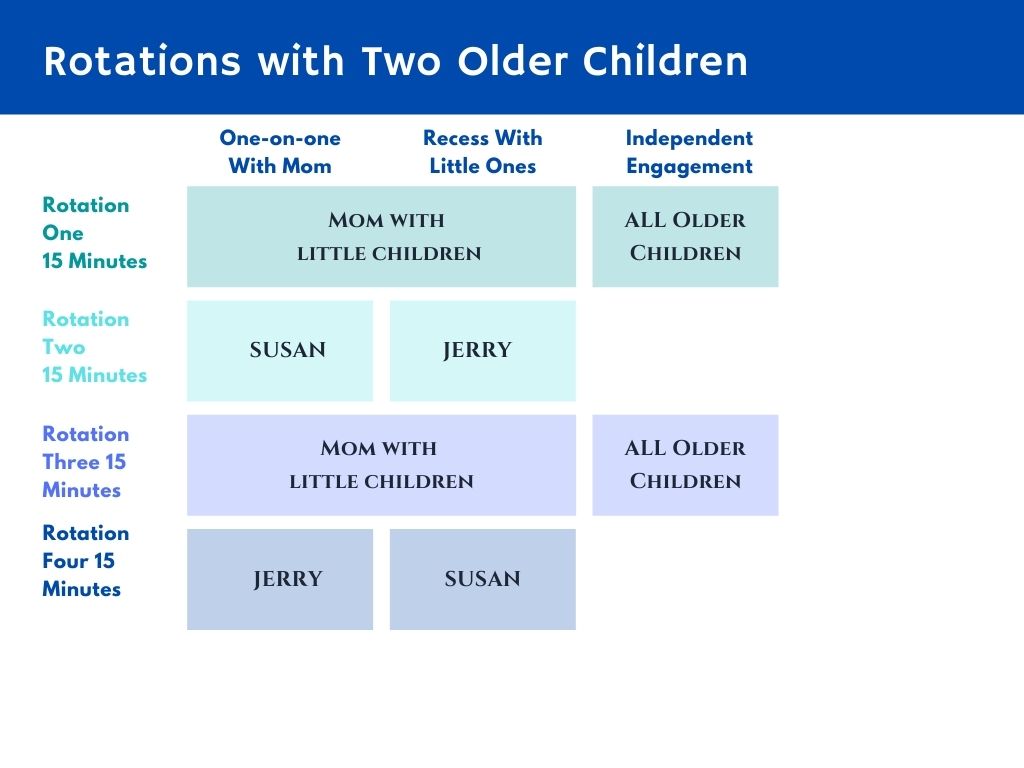
Jerry has Independent Engagement, the Recess, then Independent Engagement, and then one-on-one.
Susan has Independent Engagement, the Onee-on-one, then Independent Engagement, and then Recess with the little ones.
Rotations with One Older Child and Little Ones
In this case, there is no one to watch the little ones. I suggest you take a 15 minute walk, do exercises together in the living room, or go to a park with all he children. Then do a 90 minute quiet time after lunch. During quiet time, let the older child take 15 minutes Independent Engagement, then take 15 minutes one-on-one with the older child, and then give them 15 minutes Independent Engagement. All this while the littles are in quiet time.
Just Two Hours!!!
This is the formula for two hours of homeschool. The first hour in General Knowledge, covered in "How to homeschool Multiple Children with Young Ones in the Mix," (linked below). The second hour is for skill learning and development, as outlined above, rotating between One-on-one, Recess with little ones, and two rotations in Independent Engagement for each older child.
Just set a timer. Have a chart and guide each child to their segment. It will take a few weeks, but as you get consistent, and they see they really can pursue their interests, you will see their love of learning take off. You can do this! Enjoy the journey!
Click below to read the first article in this two article series and learn "How to Homeschool Multiple Children with Young Ones in the Mix."
If you've found value in what I've shared here, I warmly extend an invitation for you to subscribe to our FREE Newsletter. Inside, you'll discover a wealth of helpful tips tailored specifically for home-school moms. Explore a range of topics including homeschooling, family culture, mom culture, and effective home management strategies. Stay in the loop with updates on site news, upcoming events, new products, and exclusive offers. Come join us on this journey, and don't forget to spread the word to your friends so they too can benefit from our community!