

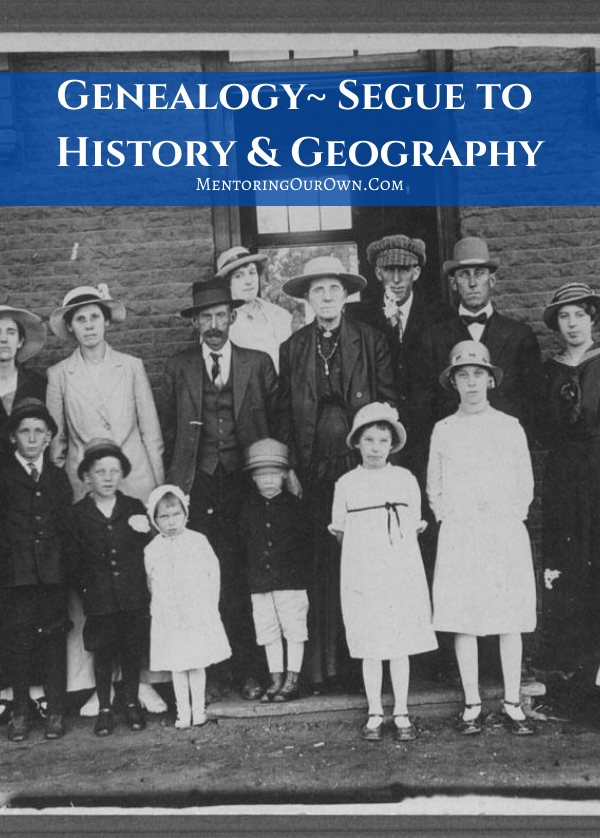
My maternal grandmother , Mary Effie Lamkin, is the woman in the white suit in the middle of the back row. She and her family (the Lamkins) were at the train station in Princeton, Illinois, on her wedding day, waiting for my grandfather, Clark, to arrive for the wedding. January 1921.
I have discovered that the study of one's family genealogy is a great segue into the study of history, geography, research, writing, and math.
What is Genealogy? It comes from two Greek words, one meaning generations and the other meaning knowledge.
As we study and research our ancestors, we can often discover where they lived, the conditions that caused them to move, the routes traveled, occupations, and more. Their stories can inform, inspire, and strengthen us.
The best place to start...
The best place to start is with you, your immediate family, and where you live. As families do this together, they begin to see and understand that they are a part of history. Then add their granparents, moving back a generation at a time. Sometimes, there is little information, include that. Research the area they lived. Census records, church records, land records, ship records and court records can provide a lot of information. Children can even interview older relatives!
When I was a child, I lived in Hawaii, thousands of miles away from my relatives. All my friends could rattle off that they were 1/4 Hawaiian, 1/4 German, 1/2 Chinese, or other combinations. I knew nothing of my heritage and I began to ask questions with few answers. When we visited the Mainland USA, my father and mother would take me back to visit their aunts and uncles. I asked questions and began to get answers.
When I was in college, my Aunt Grace went to Germany with her daughter. My cousin had been an exchange student in Germany. They were going to visit her exchange family. My aunt knew I had talked with her uncle in Indiana. He had taken me to the little German Lutheran Church that her great-grandparents had attended. I searched the church records. I discovered the town in Germany they had come from. I discovered the town that her great-grandparents had come from. I gave Aunt the name of the town. When she got to Germany, she hired a genealogist to assist her. She brought home lots of family history.
Genealogy had been easy for my Uncle Bill, my Aunt Grace's Quaker husband. They lived in a stone home in Pennsylvania. That home had been in his family for over 200 years. They lived a block from the church, where his family had attended that church. The cemetery next to the church is where his family was buried. There were ancestors buried in that cemetery going back over 200 years. He just walked over to the church and was able to get the signatures of his family members who had lived the previous 200 years. Easy peasy! So, my Aunt wanted to know her roots. Several years later, she wanted to belong to the Daughters of the American Revolution. So, she contacted me for help.
We have since discovered pilgrims, patriots, pioneers, benevolent monarchs, a Scottish Highland chief, Huguenots, the Grand Sachem of the Montaukett tribe, as well as terrible tyrants, sheriffs, blacksmiths, ministers, judges, lawyers, craftsmen, doctors, farmers, teachers, soldiers, officers, brave mothers, courageous fathers, and more. We researched and followed their journeys across continents, we learned of the history of their time, and wrote about it.
We discovered through our research that 7/8ths of our ancestry were in America prior to the Revolutionary War. Two great-great-grandparents of mine traveled to America from Germany as children, and as adults, they met and married.
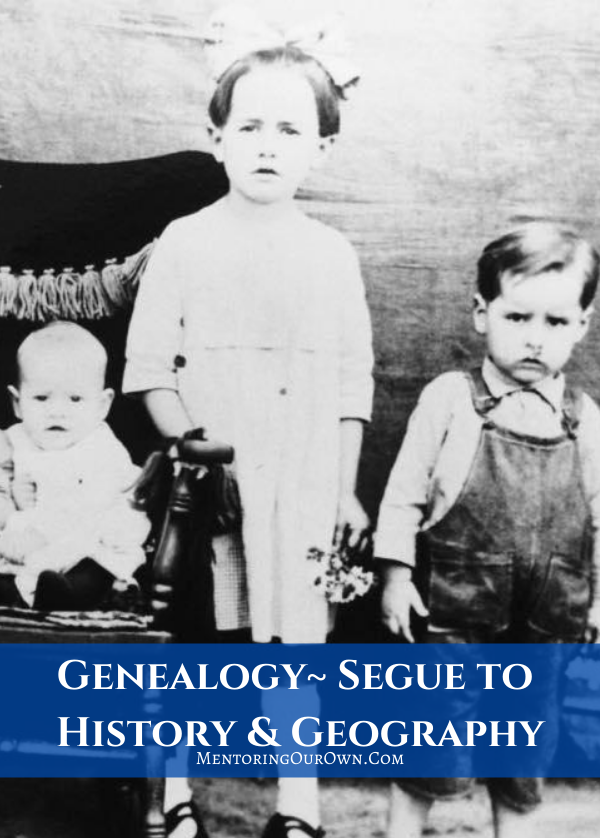
My father is the baby in the picture, along with his siter and brother. 1924!
On 17 September, we commemorate Shiffbruchs Gottesdienst (Shipwreck Thanksgiving Feast), with our family. That was the date of Heaven's rescue.
In May 1831, a group of my ancestors, their relatives, and close friends left Darmstadt, Germany. They traveled over 400 miles to board the ship, the Brig James Beacham Galt, for Baltimore, Maryland. They left because their sons would be conscripted into the military at sixteen. They also found that they could buy land in Ohio for $2 an acre. My twenty-three-month-old great-great-grandmother, Elisabeta, was on board. She was traveling with her parents, her mother’s parents, her mother's three sisters, as well as many cousins and some neighbors. There were about 160 passengers in all, and most were related. The ship they traveled on was brand new and was on its maiden voyage. It was their captain's first Atlantic crossing voyage. After sixty-five days on the Atlantic, they hit a hurricane and were tossed for two days. They lost their mast, and their rudder, and were taking on water. The crew almost mutinied. However, they were prevented from doing so, by relatives with guns.
Soon, a brave fourteen-year-old cousin, Margarethe Arras, suggested that Jesus calmed the seas and saved his disciples. She said that maybe he would save them. It was nearly midnight and the ship was taking on water fast. A crew suggested someone slap her and that they were all going to drown. She stood and began singing the Lutheran hymn, A Mighty Fortress is Our God. The passengers and many of the crew joined in. Shortly, the seas calmed and the ship rested on a sandbar, off the coast, just south of Cape Henry, Virginia..
At dawn, they discovered they were about one hundred yards offshore. This was just three weeks after the Nat Turner Slave Rebellion, less than eighty miles away, in Southampton, Virginia. Though there was racial tension in Virginia, it was slaves on Cape Henry, who came to the rescue of the passengers. The slaves along the coast were their benefactors. These passengers were from an area of Germany where they had never seen a person of color. They were at sea when the uprising happened. These Germans had not yet seen American slavery. The passengers were grateful to God and the rescue he sent. The passengers vowed to celebrate the day of their rescue, as a holy day, unto the third, and fourth generations. They nicknamed the ship, the Famous Dove. I am the fourth generation descendant of one of the youngest passengers on board the Famous Dove. All of the passengers and crew survived, except for a child and an infant who died crossing the Atlantic.
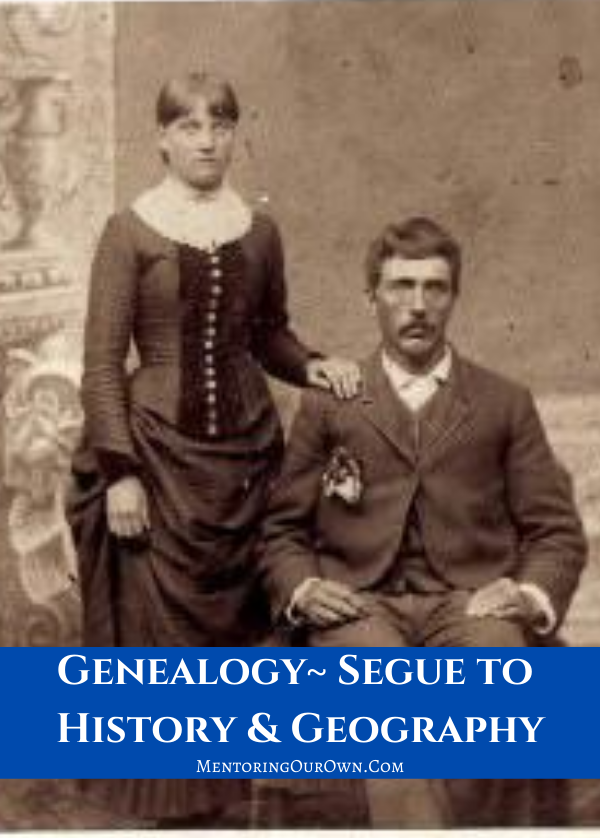
My maternal great- great grandparents, Elisabeta Marquardt and Jakob Flach, on their wedding day. November 1850, Allen County, Indiana.
It took about five years for these immigrants to work their way to Maryland, then to Pennsylvania, and then to Ohio. My direct ancestors moved on to Indiana, where my German great-great-grandmother, Elisabeta, met my German great-great grandfather, Jakob, (who came to America in 1836 as a child) and they married.
When I was a child, the only vestige of this story that was passed to me was that I had a group of ancestors who got permission from the Duke, to come to the United States to avoid military conscription.
The above story is the rest of the story or at least a lot more of it. However, this is just one incident in the lives of two great-great-grandparents.
In the process of finding out more about our family genealogy, we engaged in research, writing, history, geography, some math, and more. When looking at the stories mentioned above, one can see many gateways into learning, that could lead to other research. In the process, a student would read, research, learn history, learn geography, would use math, and writing. Some call this project-based, and it is. Others would call this unit studies, and it is. Others would call this "Notebooking," and it is that, too! One thing we did in our homeschool was create a history timeline on the wall in the dining room. I had the children to write in their birthdays, their parents' birthdays, and the day their parents got married. I wanted them to see themselves and our family as part of history. We also encourage children to include their family history in their Book of Centuries. Also, along with current events, by studying the Power of an Hour, children will learn about other lands and they can notebook that into their Book of Nations and timeline, as well. This helps them see their family genealogy in the context of history. We also included a giant map on our dining room table and covered it with clear vinyl. Then when we studied family genealogy, history, geography, or learning about current events, we could easily refer to the map to see where things happened. Studying their family genealogy became a gateway to further learning.
What adventures await your family in adding genealogy to your homeschool studies? I invite you to consider adding family genealogy to your home education studies, it makes for a great unit study, project-based study, or notebooking. The great thing about studying family genealogy is that the children do not even need to know they are doing school, geneaolgy can spark their curiosity, there is a lot to learn, and there is no busy work!
Enjoy the Journey!
___________________________________________________________________
If what I shared here resonates with you, I invite you to sign up for our FREE newsletter where I write about homeschooling, family culture, mom culture, and home management. I also keep you informed of upcoming events, new products, and special offers. Please share with your friends, so we can journey through this season together!