

A Holistic Path to Effective Homeschooling
Starting homeschooling can be a daunting task, with many parents seeking the perfect curriculum to guide their children's education. However, the key to successful homeschooling may lie in adopting a more holistic approach, much like riding a bicycle. Just as a bicycle requires balance, direction, and consistent movement, a well-rounded homeschool education involves more than just academics. It requires considering other aspects that influence children's hearts, allegiances, character, work ethic, brain development, core body balance, executive function, socialization, and more. This comprehensive method helps nurture well-rounded individuals who are prepared for both academic success and life beyond the classroom.
The Handlebars: Guiding and Controlling Your Homeschool Journey
Handlebars direct the bicycle, control speed, and provide braking when necessary. Similarly, there are foundational elements in homeschooling that offer direction, structure, and the ability to pause and adjust when needed. Without these, children may struggle, become easily distracted, and fall behind. In my home, these non-negotiables are integral to our homeschooling approach. We established them early, even before our children reached school age, and they are essential for every family, whether homeschooling or not.
The Christian Path
Teaching about God, personal prayer, and personal devotions is the cornerstone of our homeschool. Cultivating a kind, thankful, and discerning heart, and learning to choose right from wrong, truth from error, and good versus evil, are fundamental lessons.
Discipline of Habit
Without discipline, children rarely develop the work ethic needed for scholarly learning. Consistent habits lay the foundation for success in academics and beyond.
Family Work and Shared Work
In our home, family work is where relationships are built, and character is developed. Children feel valued as they contribute to the household, learning to do quality work, pay attention to detail, and follow through on tasks. The character developed through family work translates into academic success.
HomeCulture
Refinement, graciousness, and socialization begin at home. Parents lead by example, teaching comeliness, hospitality, table manners, civility, kindness, and respect. Home culture can be enriched with the study of the Lost Arts Series and Classic Character Unit Studies.
The Daily Walk
Daily walks, fresh air, and active play are crucial. Physical activities like crawling, walking, running, balancing, brachiating, climbing, spinning, sliding, and swinging help build brain tissue, integrate the left and right brain, and strengthen core body muscles. This, in turn, enhances attention span and focus.
Can You Really Homeschool Multiple Children of Different Ages
in As Little As Two Hours a Day? YES!!!
Children typically have short attention spans, around one minute per year of age. Short, focused lessons capture their attention, and variety keeps them engaged. Long, stressful lessons can trigger survival mode, not learning mode. In the elementary years, we aim to broaden their horizons, spread a feast for their minds and hearts, and nurture a love of learning.
The Front Wheel Rotations Take You Where You Want to Go
The Power of an Hour: Gateway to a Classical Education
The Power of an Hour: Gateway to a Classical Education - (about 1 hour a day) is a family-style spiritual and intellectual devotional time, akin to a cottage school (micro school) approach is as easy as 1, 2, 3!
1) Bible Study
2) Classic Read Aloud and Discussion
3) Daily Gateways into learning that expand horizons and provide food for thought. Click here to view the Scope & Sequence covered in the Power of an Hour."
Scripture study and read-alouds have been part of our routine since our children were toddlers.
The Rear Wheel Rotations: The Power Behind Your Progress
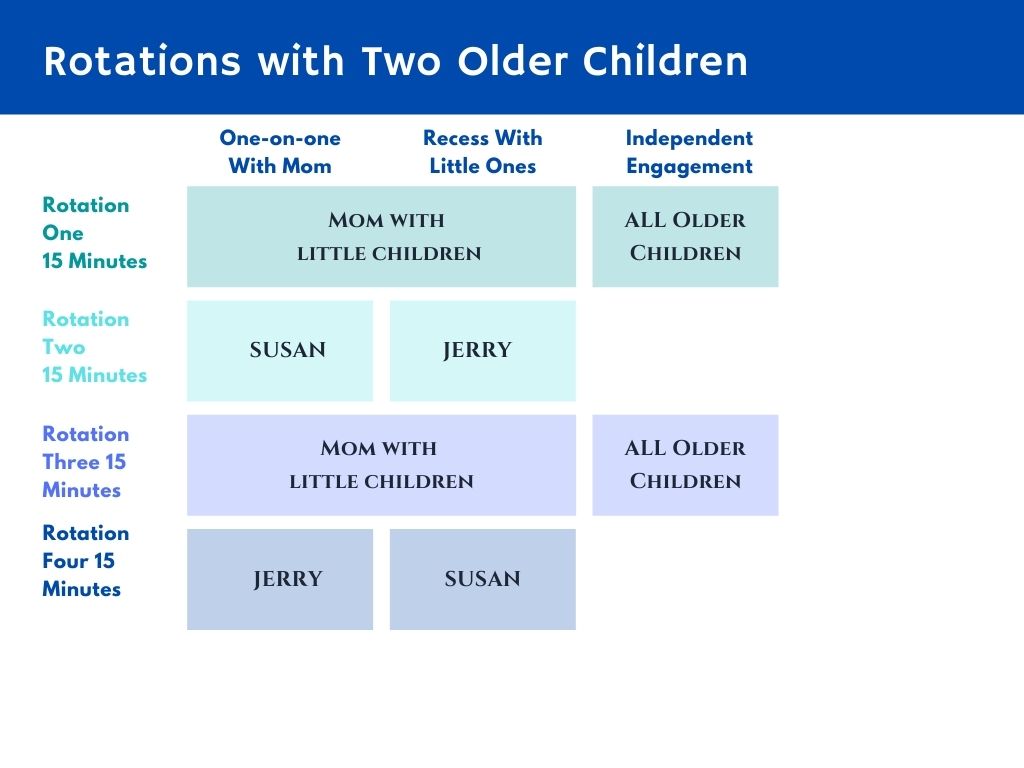
Three non-negotiables happen concurrently (about an hour total, each day), where skills are taught and honed. Each rotation session begins short and expands as attention spans grow. Start with the youngest, focusing on their needs, while the others engage in independent learning, then rotate through each child.
Mentoring
One-on-one mentoring provides the necessary coaching, encouragement, and assistance with specific learning needs, whether it's reading, math, or personal development.
Recess
Recess allows for play and interaction, giving children a break and a chance to engage with their younger siblings.
Independent Learning
While mentoring one child, others engage in independent learning activities like transcription, reading, memorization, and project work.

What if You Have Only One School-Aged Child and Younger Children?
If you have one school-aged child and younger children, recess together as a family. Establish a quiet time, and use 15 minutes to teach the oldest child one-on-one.
What if You Have No More Younger Children?
As your family grows older, adjust the schedule to have everyone in independent learning while you mentor each child individually. Recess together and play games. Older children will eventually transition to self-directed study, contributing to family discussions and Bible study.
Using the handlebars and both wheels will propel you far on the path of education for life!
Enjoy the Journey!